Museums around the world are incorporating new technologies into the exhibition and management of their holdings. Complex computational technologies falling under umbrella of ‘AI’ are a major part of these developments, but they are often poorly mediated to audiences, if at all.
We believe that museums are facing new challenges as they respond to the latest technological developments in machine learning, but that they can also function as independent, critical spaces for debating the ethical, cultural, and social implications of AI.
Our project addresses urgent issues that are arising at this nexus of culture and technology including :
- the potential of museums to function as sites of Explainable AI;
- the risks posed to the values of human creativity and intellectual property in exhibitions of or involving generative AI;
- the implications of integrating algorithms into the act of curation;
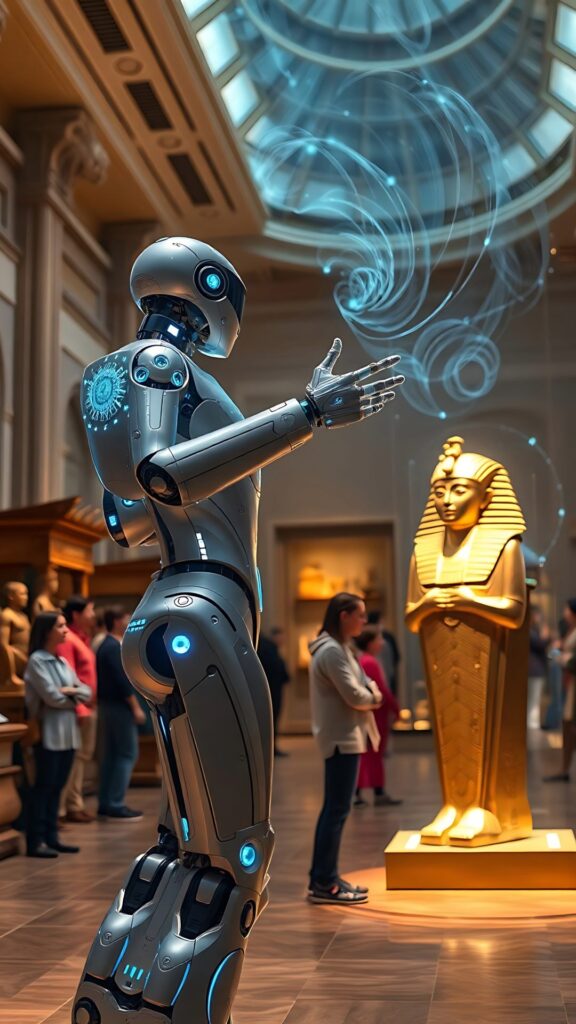
- the social consequences of using of AI-based conversational agents as educators;
- the environmental impact of using AI in museum operations;
- the possibility of using heritage spaces to open debates about the wider uses of AI in society;
- the potential of AI to provide insight into visitor experience and to develop new approaches to exhibition design;
- the need for sensitivity to different cultural attitudes regarding technology.
Using principles of value-sensitive design in the creation of new heritage tools and spaces, we seek to open discussion about the possibilities of developing an AI cultural heritage that responds ethically and transparently to a plurality of voices and perspectives.
Our project parters include The Ashmolean Museum, Oxford; The Francis Crick Institute, London; and The Salk Institute for Biological Studies, La Jolla.